The University of Salento asked for a virtual museum inside its real one: a way to experience objects visitors can never touch. Radium watch dials, uranium glass, radioactive lightning rods, all out of reach for good reason. Design problems and technical problems carried the same weight, and AI played a central role in both. I tested several tools, then asked a simpler question: why not build custom software for experiences like this one?
Room 1, the model for the ten that follow, was presented at the Festival della Scienza in Genoa and is now online. Concept, design, 3D and the software were mine.
This article follows the same split: first the experience, then the tool that builds it.
Part One · The ExperienceSix Questions Before a Single Model
Every later decision answers one of these.
Different Audiences
One path for a child, a curious adult and an expert?
The Value of 3D
How does 3D avoid becoming a stage set?
Orientation
How do you never get lost, and remember what you saw?
Mediation
Readable without distracting, with a guide that has a real job?
Content to Experience
How does information become something you do?
Totem to Web
Same experience on a totem, a desktop and a phone?
With those six questions answered, I started producing quick concepts with AI and presented them in a pitch, to agree on a direction with the University before building anything.
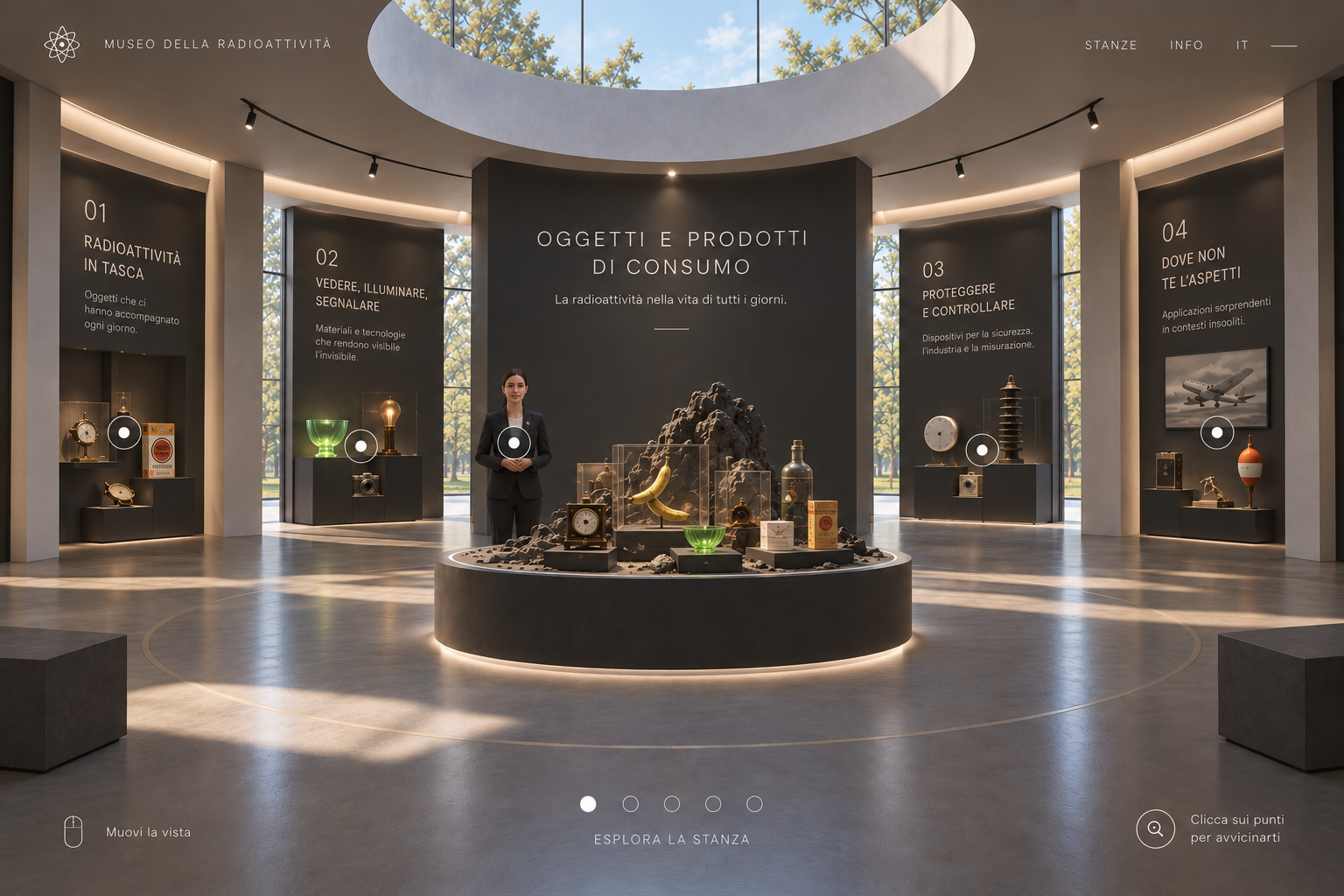
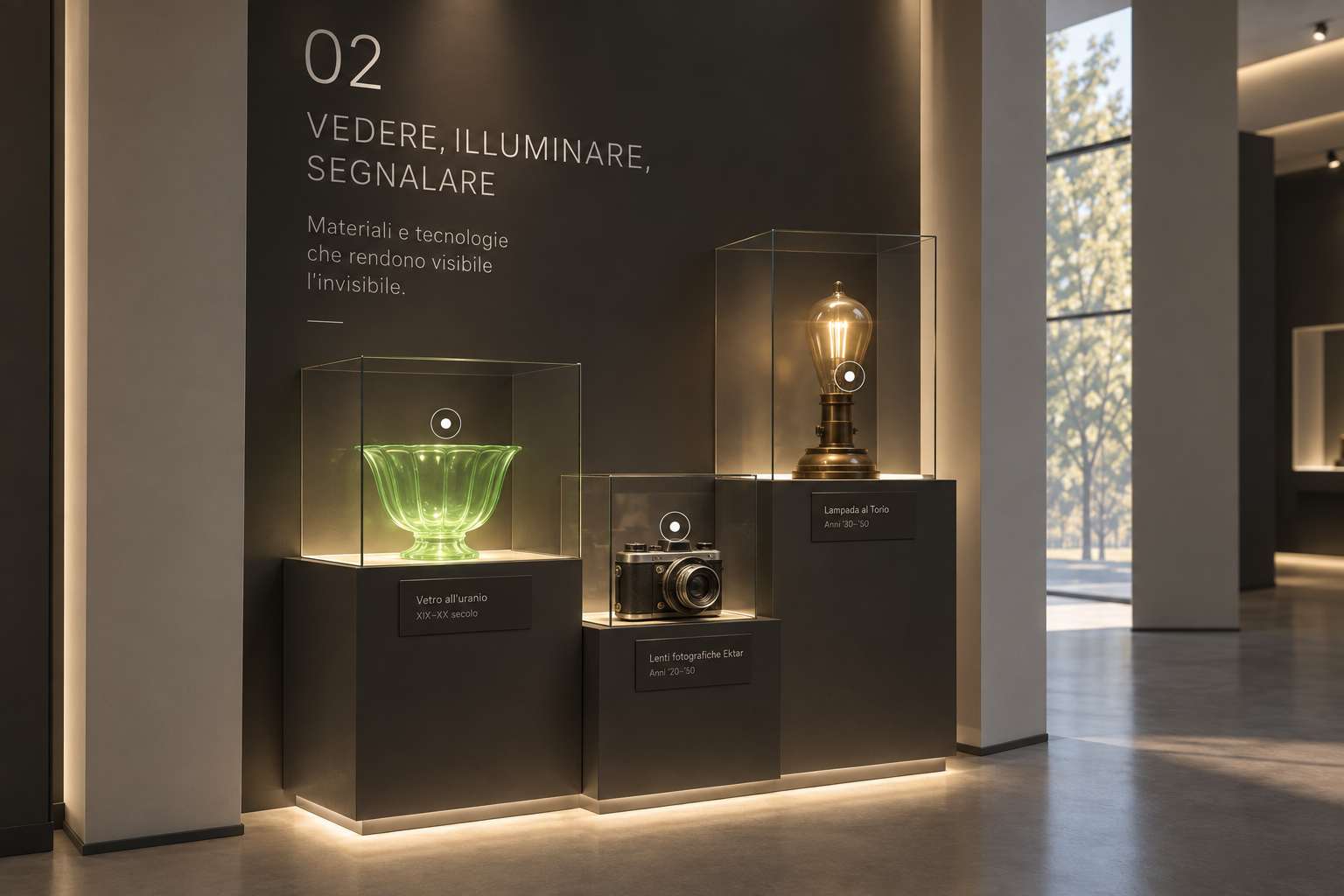
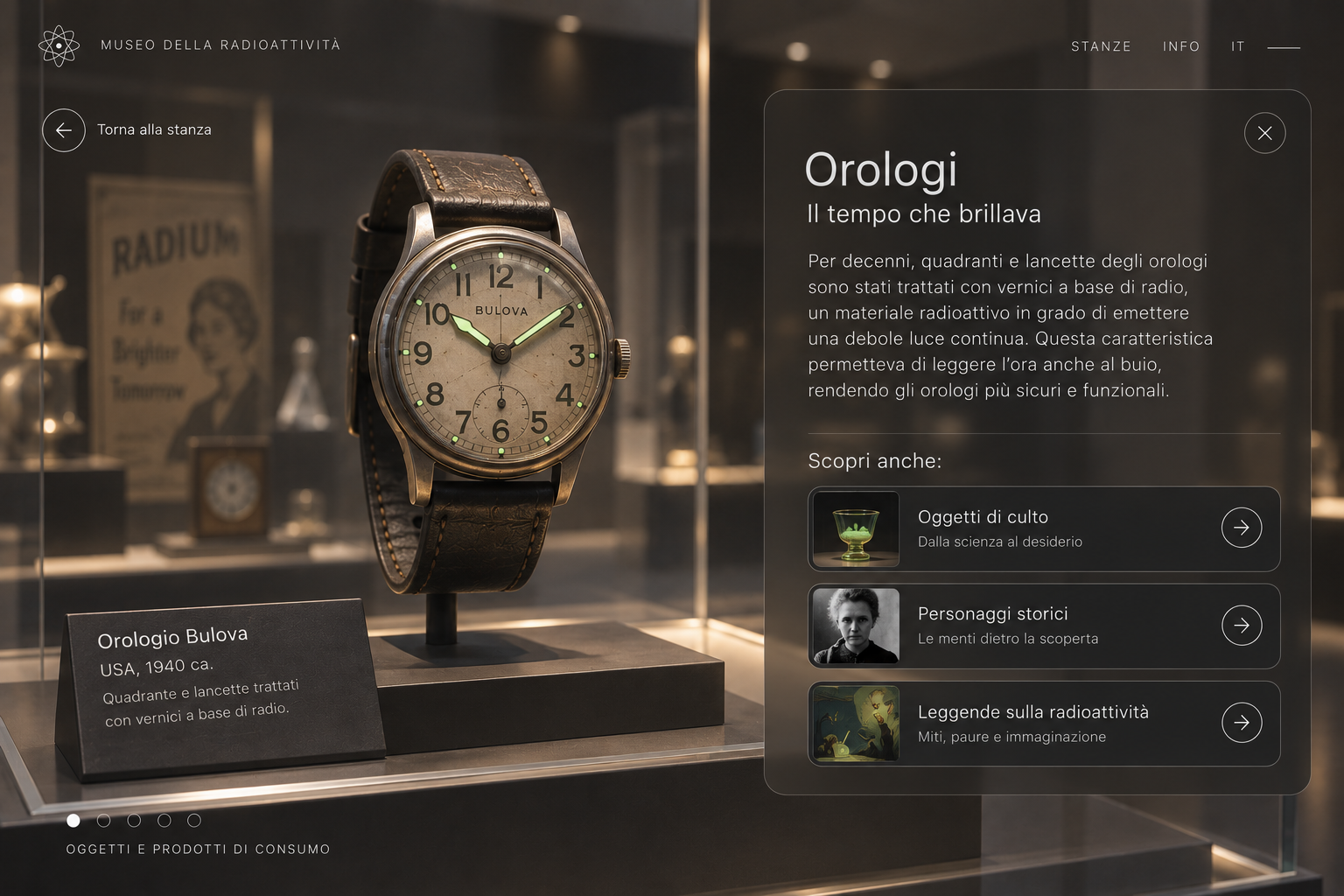
Custom Paths, Not a Boring Slideshow
There is no kids' mode and no expert mode. Every visitor walks the same path and decides how deep to go, so each visit becomes a path of its own. Names and groups of objects were rewritten for a general audience before anything was modeled.
The Passer-By
Little time, wants an impression. The room gives it at a glance.
The Curious
Follows what catches the eye, one group at a time.
The Expert
Goes all the way down, to the object, its story, the guide.
The closer you get, the more you learn.
The 3D has two jobs. It informs: objects you cannot touch rise from their pedestal and turn in your hand. And it orients: the room is circular, every group visible from the center, so the space is its own map.
Interaction Design
The interface was built around one idea: simple enough for anyone, complete enough to never leave you stuck, and shaped around moving through space. Four principles came before any button.
No Dead Ends
From any detail you return to the group you came from, with the same framing.
Memory of the Path
Every pin shows whether its content is unseen, explored or seen.
Learn by Doing
A switch turns off the room's light, and an object starts to glow.
The Voice Tells, the 3D Shows
Two roles, never competing.

Marie, the Guide
Marie, named after Marie Curie, welcomes visitors, introduces the museum and answers their questions, with answers written together with the curators. She is built in Character Creator, speaks with a voice generated from the text and a lip sync derived from it, and moves through a mixer inside the tool.
The next step is already planned: Marie will become a conversational guide, able to answer free questions from the museum's own knowledge, with the same face and the same voice.
User Tests
The tests were observational: while the scene was being built, I watched people use it without guiding them. Fifteen visitors of different ages, eight baby boomers, five millennials and Gen Z, two Gen Alpha, on desktop and phone. Two behaviors changed the design.
Stuck on the Podium
The navigation was a slideshow in disguise. Now the buttons are spatial: back is a step back, left and right move at the depth you reached.
Looking for the Way Out
People searched for the exit on the card. A close button now sits there, and back moved closer to the eye.
One Tool to Build Them All
Technique was there to serve the design, not the other way around. I evaluated several solutions, mainly Unity and Spline, but the experience needed a lean system, built on three.js, easy to edit and made to measure. So I designed an editor that runs in the browser with the museum inside it, speaking the museum's language: rooms, exhibits, shots, the guide. It is internal, but designed as a product for small teams building exhibitions and showrooms.
The tool is called SCUMM, Scene Compositor Utility for Multimedia Museums, borrowed with affection from the engine Ron Gilbert and Aric Wilmunder built for Maniac Mansion in 1987.
Room
Scene, objects, shots, texts.
Stage
Guide, camera rules, look.
Design
The visitor's interface.
Library
Every file, swappable.
Publish
Outputs and delivery.
An Architecture Built to Scale
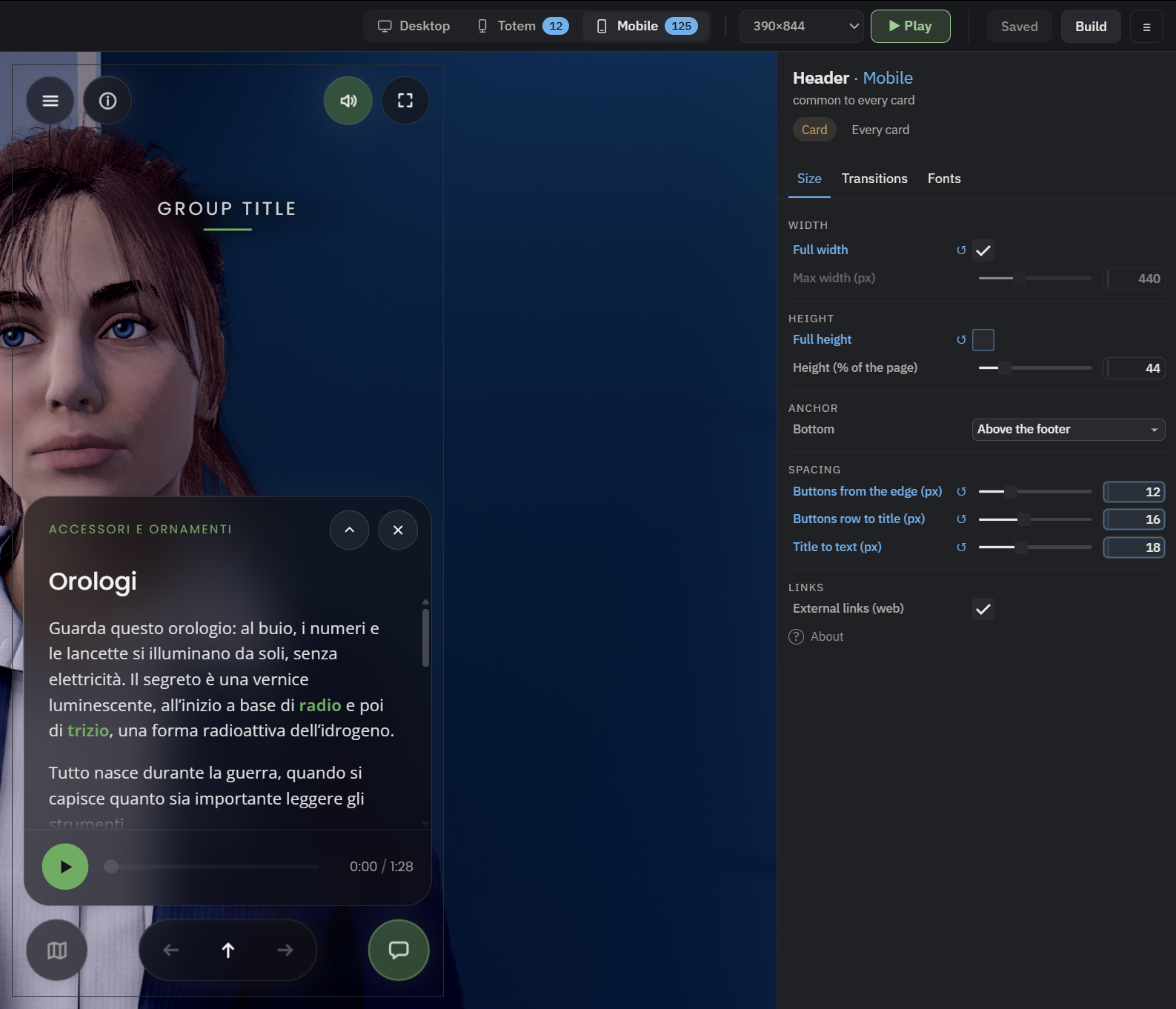
Rules and settings were built custom, for exactly what the museum needed. Desktop is the base, Totem and Mobile are its differences, and every difference is blue: the only other color with a meaning in the editor is bronze, for act here. Cameras follow rules set once for the whole museum, so the second room never starts from zero.
A setting exists on every output or none.
Any change from Desktop, even position and order, shows in blue: in the field, in the list and in a counter next to the output.
Mobile settings used to live in nine places. Now one number answers "what changes on the phone?".
Level of detail by context, computed on load with no extra files.
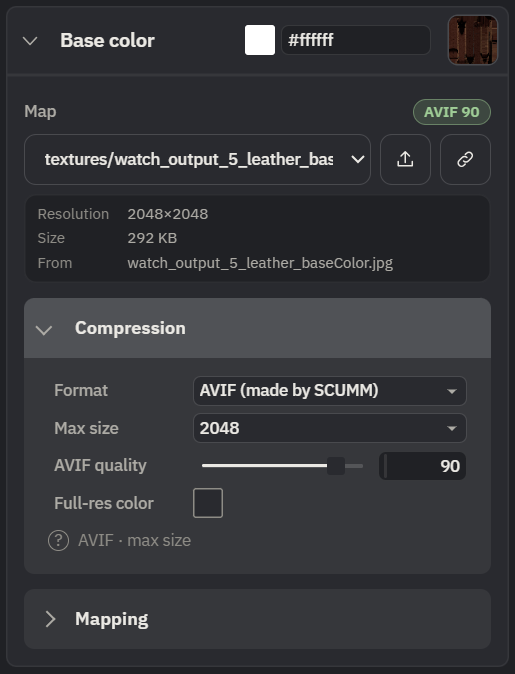
Models compressed as far as they go, light baked into the textures, textures compressed on arrival in the right format for their role.
On the phone, same view: draw calls from 828 to 297, triangles from 1.07 million to about 380,000.
A true planar reflection redrawn only when something changes. Lights written into shaders that touch only the guide or the open object. Hair as one mesh in two passes. Glass that refracts only up close. Every effect measured on the real machine.
Technique is there to serve the design, never the other way around.
Words, Written Once
The same text lives on a 3D label, in a card and in Marie's voice. It is written once in the editor, and from there the tool orchestrates the rest through APIs: it calls ElevenLabs to generate the voice, gets the audio back already linked to the right moment, derives the lip sync from the text and updates every label and card that shares it.
Write
A line, in the editor.
Voice
ElevenLabs via API, audio linked back.
Lip Sync
Derived from the text.
Scene
Labels and cards update.
Directing the Agent
Around 46,000 lines, 279 commits in a month, written by an AI agent, Claude Code. My work was the architecture: the vocabulary, the rules, the interface approved as a mockup before any code, every result verified on the real screen.
State First
Each session starts from a status document.
Decisions on Record
Dated, with their reason.
Tests as a Net
Change a lot, break nothing.
Claude did not stop at building the tool. It also uses it: some of the manual operations inside the editor are run by Claude directly, as if through a connector. So AI works on every side of the software. An agent builds it, an agent operates it, and the tool in turn orchestrates AI services like ElevenLabs to produce the museum.
From a Museum to a Showroom
This was a stimulating project, and a complete one: design, technology and craft in the same piece of work. Testing showed that exploration has to be defended at every step, because the slideshow kept trying to come back through the buttons. The tool is what keeps that discipline cheap, room after room.
Swap radioactive objects for products, and the same layer of control runs a brand showroom. Ten more rooms come first, then a tablet output and VR as a new way into the same spaces. And the other natural evolution is Marie herself, growing into a conversational guide.